
What Is Zorba the Buddha? Osho's Formula for Success Without Emptiness
Most people who chase success eventually ask the same quiet question: why does having more not feel like enough? Osho spent decades answering exactly that question, and his answer had a name: Zorba the Buddha. It isn’t a call to give up wealth or ambition, and it isn’t a call to abandon the inner life either. It’s a specific philosophy for holding both at once, and it may be one of the most practical pieces of Eastern thought for anyone building a career, a business, or a life in the modern world.
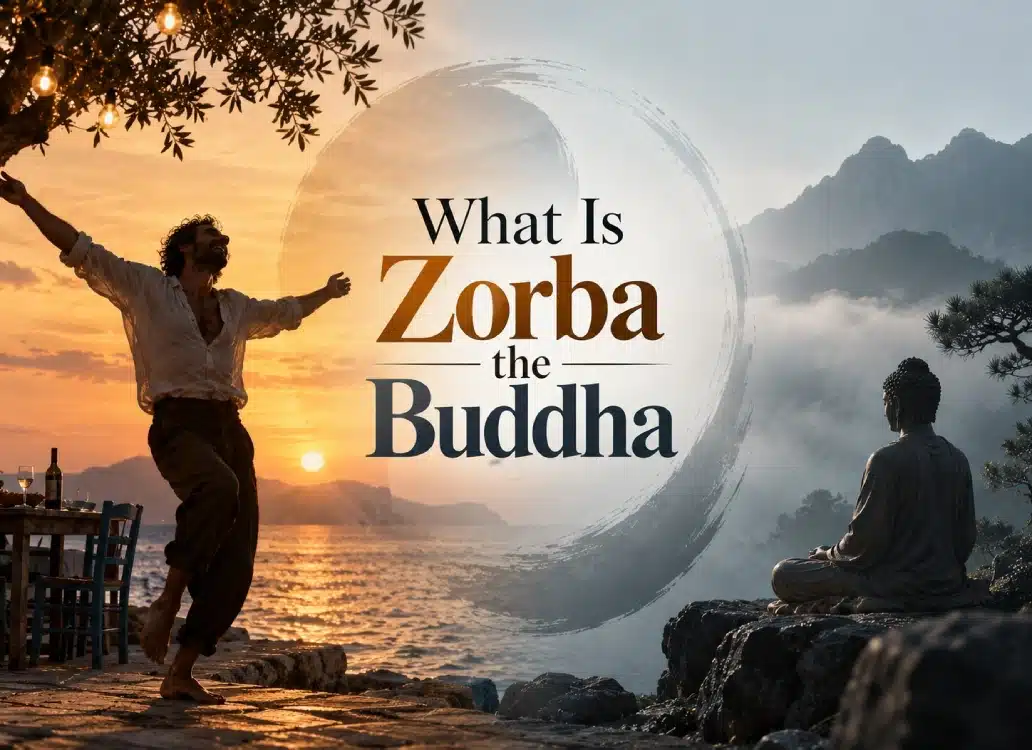
Zorba the Buddha is Osho’s concept of the “complete man”, someone who lives fully in the material world like Zorba the Greek, the earthy, life-loving character from Nikos Kazantzakis’s novel, while also carrying the inner awareness of a Buddha. In Osho’s own words, Zorba the Buddha represents the synthesis of matter and consciousness, a declaration that there is no real conflict between being rich in the world and being rich within.
The idea isn’t that wealth and spirituality are opposites to be balanced in careful proportion. It’s that treating them as opposites in the first place is the actual problem.
Osho built this idea as a direct rejection of two paths he saw as incomplete. One path, pure materialism, pursues money, status, and pleasure but leaves people feeling hollow no matter how much they accumulate. The other path, pure renunciation, pursues spiritual purity by rejecting the world, but often produces people who are inwardly rich yet outwardly poor, disconnected from ordinary life.
Osho argued that human history has forced people to choose one identity over the other, and that this division itself is what creates suffering. His proposed “new man” wasn’t a monk and wasn’t a hedonist; he was someone who could enjoy a meal, build a business, and raise a family, while remaining aware, present, and untangled from the anxious grasping that usually drives ambition.
Osho made this argument philosophically decades ago, but modern psychology has independently arrived at a similar conclusion. A large meta-analysis covering dozens of studies found that prioritising money, possessions, and image as central life goals is consistently associated with lower well-being, more anxiety, more depression, and reduced life satisfaction.
Interestingly, the research isn’t a blanket case against ambition. A study published in Applied Research in Quality of Life found that people who saw wealth as a signal of success and effort reported higher life satisfaction, while people who believed wealth itself would make them happy reported the opposite. In other words, the problem isn’t earning or building — it’s expecting the earning itself to fill an inner void it was never designed to fill.
This is almost a modern, data-backed restatement of what Osho was pointing at: material success pursued as an identity, disconnected from inner awareness, tends to produce emptiness, not because success is bad, but because it’s being asked to do a job it can’t do.
Living this philosophy doesn’t require withdrawing from ambition. It requires changing your relationship to it.
Pursue goals without outsourcing your peace to them. Build the business, close the deal, grow the career, but notice if your calm is being held hostage by the outcome. Zorba the Buddha means the work can fail and you’re still whole.
Stay rooted in the body and the present, even while planning the future. Osho placed heavy emphasis on presence and awareness as daily practices, not occasional retreats. A five-minute pause before a meeting, real attention during a meal, noticing your breath during a stressful call – these are small acts of staying “the Buddha” while still fully being “Zorba.”
Let enjoyment be complete, not guilty. Many driven people either overwork and feel empty, or relax and feel guilty for not working. Zorba the Buddha rejects that split; enjoyment and ambition aren’t meant to compete with each other.
Measure success on two tracks, not one. Alongside revenue targets or career milestones, track something inward: clarity, patience, how present you were with people who matter. Osho’s framework only works if the inner track is treated as seriously as the outer one.
Yes, but the research and the philosophy agree on the same condition: it depends on why you’re pursuing wealth, not whether you pursue it. Osho explained that Zorba the Buddha “can have everything that the world can provide” while still holding “the flowers of ecstasy, the fragrance of godliness, the wings of ultimate freedom”; the two are not competing resources drawn from the same limited pool.
The practical takeaway is that wealth and inner peace fail to coexist only when one is being used to compensate for the absence of the other. Pursued side by side, with equal seriousness, they reinforce each other instead of trading off.
Zorba the Buddha isn’t a compromise between two lesser options; it’s Osho’s argument that the entire premise of choosing between wealth and wisdom was always false. The emptiness so many successful people describe isn’t a sign they’ve chased the wrong goals; it’s usually a sign the inner half of the equation was left unattended while the outer half sprinted ahead. Building both, deliberately and at the same time, is the actual formula — not balance, but wholeness.