

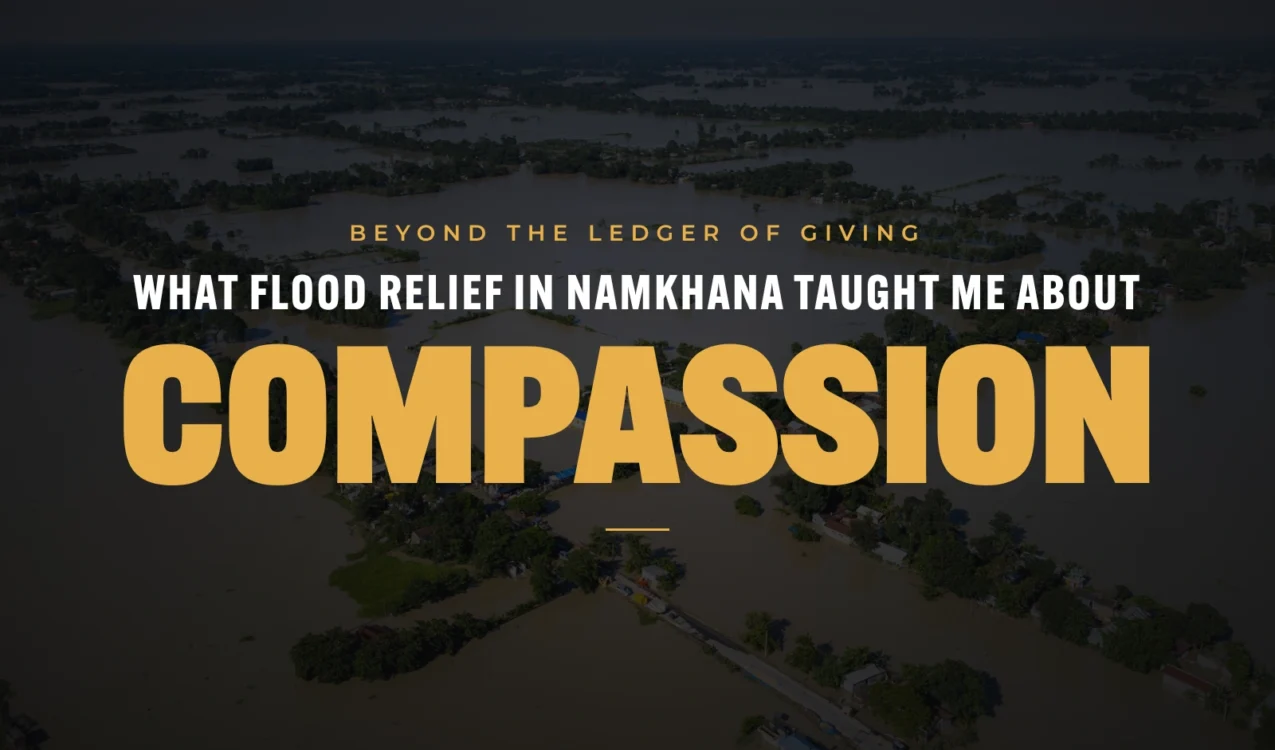
Beyond the Ledger of Giving: What Flood Relief in Namkhana Taught Me About Compassion
The road into Namkhana dissolved long before the river began. What remained was a slick, grey ribbon of clay cutting through breached earthen embankments, drowned paddy fields, and thatched roofs tilting under the heavy coastal sky of South 24 Parganas. When saltwater breaches the dykes along the Hatania-Doania and pushes south toward Bakkhali, it does not arrive as a dramatic wave. It settles in as a quiet, suffocating siege, contaminating tubewells, spoiling stored grain, and reducing weeks of hard-earned stability to knee-deep marsh.
Standing on that sodden ridge, working alongside the team from the Parrot Dipankar Charitable Trust, my immediate reality was entirely physical: lifting coarse burlap sacks of rice, stacking dry rations, and hauling bundles of clean clothes out of the back of the truck before the low monsoon clouds burst again.
Yet as the hours blurred into mud and sweat, the physical effort brought to mind a deeper, uncomfortable question, one that Osho spent decades exploring: What separates the urge to help from the subtle desire to be seen helping, and where does kindness end and genuine compassion begin?
Disaster zones have no use for uncoordinated goodwill. The coastal communities across the Kakdwip subdivision do not need grand gestures; they need precise, logistical dignity.
Early in our planning with the Parrot Dipankar Charitable Trust, we had to confront the reality that good intentions can easily turn into logistical deadweight. Unsorted goods, unrequested supplies, and damaged clothing only clog transport and overburden local volunteers. The discipline of the field demanded a strict set of principles:
• Assess before dispatching: We verified what families had actually lost. They did not need surplus junk; they needed the basic means to light a stove, dry rice, lentils, immediate food supplies, and fresh clothing.
• Preserve recipient dignity: Donating damaged or soiled fabrics is not charity; it is disposal under the guise of virtue. Everything we handed over was clean, dry, and usable.
• Rely on local roots: A local trust understands the human geography of the villages. They know which elderly neighbour is stranded beyond a collapsed bamboo bridge, which family has an infant, and which pockets have been skipped by standard distribution lines.
When you hand a fifty-kilo sack of grain to a family whose home has just been washed out, it is alarmingly easy to feel righteous. But Osho drew a sharp, provocative distinction between kindness and compassion:
“Kindness is an ego-attitude. Compassion is not an attitude at all; it is a state of being. Kindness always expects something in return, at least a ‘thank you’, at least a recognition that you have done something good. Compassion simply flows, because you have it to share.”
Most charity remains caught in the net of kindness. The giver remains the centre of gravity; the receiver becomes an accidental prop. You leave with a warm conscience, perhaps a photograph, and an unspoken internal receipt that reads: I gave.
Compassion, as Osho framed it, has no protagonist. It is entirely unmotivated and uncalculated. When an earthen pitcher spills over, it does not do so for praise; water simply pours because it is full. A meal handed across a mud embankment should carry the same absence of theatre. It is not an act of benevolence; it is just an instinctive, practical response to hunger. The moment I register myself as “the benefactor,” the act is reduced to subtle self-interest.
Pity looks down; empathy tries to match pain; compassion simply acts without an audience.
In Namkhana, the men and women coming forward were not helpless victims waiting for a savior. They were cultivators, fishermen, and artisans facing an unforgiving tide with quiet, stoic endurance. To approach them with pity would have been an insult to their grit.
True relief work demands a few quiet internal disciplines:
• Treat recipients as equals: This removes the invisible hierarchy between the hand giving the sack and the hand taking it.
• Drop the expectation of gratitude: This frees the other person from having to bow, smile, or perform thankfulness in exchange for survival staples.
• Respond to need, not convenience: The community’s immediate necessity sets the agenda, never the donor’s surplus stock.
When an elderly woman takes a bag of grain, looks straight into your eyes with tired, steady recognition, and nods without theatrical subservience, the boundary between the helper and the helped vanishes. You realise you are merely returning what circumstances temporarily took away.
Giving does not deplete the giver. In spiritual terms, holding back tightens our inner space, while letting resources move outward keeps life moving. Sacks of grain, dry clothes, and clean drinking water are the material world at its most immediate and practical. Sharing them without keeping score is the contemplative side of the same coin.
For anyone who builds, earns, or works in enterprise, resources remain hollow until some of that energy moves outward to places where the ground has eroded. You do not need to wait for a quiet, perfect moment of spiritual clarity to act. You begin with the material at hand, renting the truck, packing the grains, and moving into the mud.
If Osho warned that true compassion must be invisible and unmotivated, does writing about this relief work not flirt with the very ego he criticised?
The tension is real, and it cannot be brushed off. But documenting an effort like this is justifiable only when it points toward the work and the process, rather than the person who showed up.
It holds value only if it:
1. Keeps the community’s dignity intact, refusing to use their hardship as emotional set dressing.
2. Directs attention and credibility to grassroots partners like the Parrot Dipankar Charitable Trust, whose logistics make actual relief possible.
3. Serves as a practical reminder that you do not need vast wealth or special status to be of use. You only need to verify what is needed, pack the vehicle, and step into the mud.
The floodwaters in Namkhana and Bakkhali will slowly drain, leaving behind saline earth and months of quiet rebuilding. What stays behind is simpler: compassion is not a moral badge to pin on your chest. It is the practical understanding that when another person’s kitchen is underwater, the only sensible response is to open the storehouse and get to work.