

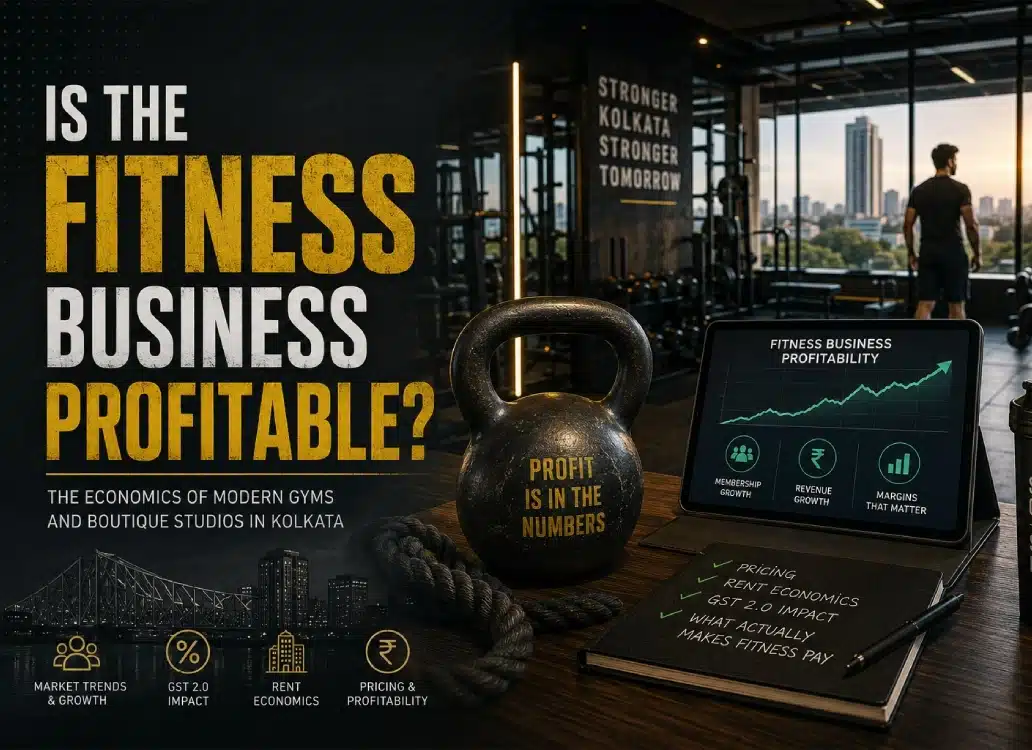
Is the Fitness Business Profitable?
Ask anyone opening a gym in Salt Lake or a Pilates studio off Loudon Street whether fitness pays, and you’ll get two very different answers depending on which segment they’re in. That split, not a simple yes or no, is the real story of India’s fitness economy in 2026, and Kolkata is a useful city to study it through, because it sits right in the middle of the national data as one of the ten metros driving the industry.
India’s fitness economy was valued at roughly ₹16,200 crore in 2024 and is projected to reach ₹37,700 crore by 2030, according to the India Fitness Market Report 2025. Gym membership is expected to roughly double to about 23.3 million people, still only around 1.7% of the population, which tells you how much headroom is left.
Ten cities are doing most of the heavy lifting, and Kolkata is one of them:
• Bengaluru, Mumbai, Delhi NCR, Hyderabad, Chennai, Pune, Jaipur, Lucknow, Kolkata, and Kochi
• Together, they contribute more than 56% of market revenue and 42% of members
• Kolkata is named specifically as one of the mature, high-investment markets, not a fringe city catching up
Part of that headroom is cultural. Fitness in India has historically been treated as aspirational rather than routine, something you did once you’d already “made it,” not a basic part of urban life. That’s shifting fast in metros like Kolkata, where a growing IT and services workforce sits at a desk all day and increasingly wants a gym or studio within walking distance of home or office, not a weekend indulgence.
Within this market, the split by business model matters more than the headline growth number. The commercial fitness industry divides into value, premium, and boutique segments, with value gyms still accounting for the majority, around 56% of revenue. But the fastest-growing slice is smaller and pricier: boutique studios are projected to grow at nearly 19% annually through 2030, reflecting a broader shift toward personalised, community-driven fitness over generic gym floors.
If you’re modelling profitability for a Kolkata gym today, one policy change matters more than almost anything else. Effective 22 September 2025, GST on gym and fitness centre services was cut from 18% to 5%, but without input tax credit (ITC). That’s a real trade-off for an owner, not just good news for members.
Here’s what changed on the ground:
• Members now pay a lower headline rate, which helps demand
• Gyms can no longer claim credit on GST paid for rent, interior fit-outs, or professional services
• Gym equipment itself- treadmills, weights, machines- is still taxed at 18%, unchanged, so capex on a new Salt Lake or New Town facility didn’t get any cheaper
In practical terms, a studio that used to price a ₹5,000/month membership to net a certain margin under 18% GST with ITC now has to re-run that math under 5% GST with no ITC. For low-margin value gyms running on volume, this is roughly a wash. For premium clubs with heavy rent and fit-out costs, losing ITC on those big-ticket inputs bites harder than the headline rate cut suggests.
Salt Lake is a good microcosm of the city’s fitness market because it has all three tiers within a few kilometres of each other. According to local pricing data from Gymlocator:
• Starmark Fitness Studio, a South Kolkata premium chain built around imported equipment and personalised training, prices its packages from roughly ₹6,400 (quarterly) up to ₹40,000 (annual)
• Cult.fit runs ₹3,500–5,500 a month
• Gold’s Gym DD30 sells annual packages around ₹32,500, or about
₹2,700/month
• Anytime Fitness charges ₹4,000–6,000 for 24-hour access with global reciprocity
• Across the neighbourhood, monthly pricing spans roughly ₹2,500 to ₹9,000, among the highest in the city, reflecting Sector V’s premium commercial rents and its corporate, tech-worker demographic
Independent boutique operators sit at both ends of that spectrum depending on positioning. On South Kolkata’s boutique side, Ballygunge’s Endorphins built its reputation on postural correction and personalised programming rather than open-floor equipment; its founder, Ranadeep Moitra, even writes a monthly fitness column for The Telegraph, which says something about how boutique studios in this city monetise expertise and credibility, not just square footage.
Other named players follow the same pattern: a HIIT-and-functional-training studio split across Salt Lake and New Alipore, a global Pilates chain’s Alipore franchise, and a Loudon Street wellness retreat blending yoga with alternative therapies. Kolkata’s boutique segment is small in headcount per location but priced for a specialised experience, not for volume.
Profitability in this business is won or lost on the rent line as much as the membership line. Retail rents across Kolkata generally run ₹50–250 per square foot, with premium strips like Park Street commanding the top of that range. Salt Lake Sector V commercial space, the address that lets a gym legitimately charge Anytime Fitness or Cult. Fit-level prices, is priced for the IT-corridor tenant base that surrounds it, not for a fitness operator’s typical revenue per square foot.
That mismatch is the central tension in Kolkata’s fitness economics. A 3,000 sq. ft. gym floor in Sector V or Park Street carries a rent burden closer to what an IT company or a retail flagship can absorb, but a gym only monetises that space at ₹2,500–9,000 per member per month, spread across maybe 300–500 members sharing the floor at any given time.
A boutique studio flips this ratio entirely. Far fewer members, but each one pays a premium for personal attention, smaller class sizes, and a service that’s hard to replicate on a crowded gym floor, so the studio needs far less throughput per square foot to break even.
There’s also a real estate lesson buried in this for anyone scouting a Kolkata location. A value gym’s biggest enemy is a lease it can’t fill; a boutique studio’s biggest enemy is a lease it can’t justify at low volume. The two models should rarely be looking at the same shortlist of properties, even when they’re a five-minute walk apart.
The honest answer is that it depends on which of the three Kolkata fitness businesses you’re asking about.
Value gyms – the Starmark Fitness, Cult.fit-style budget-chain model – run on volume and thin per-member margins. They win by filling a large floor at moderate-rent locations, not Park Street or prime Sector V, and by minimising trainer-to-member overhead. This is also where the bulk of India’s market revenue already sits, so the playbook is proven. But competition on price is brutal, and the post-GST-2.0 pricing pressure squeezes an already-thin margin further.
Premium full-service clubs, in the Gold’s Gym or Anytime Fitness mould, depend on brand trust and location prestige to justify ₹4,000-9,000 monthly pricing in areas like Salt Lake. Their profitability is the most exposed to the loss of input tax credit, since their cost base is dominated by exactly the things ITC used to offset: expensive fit-outs, premium rent, and imported equipment.
Boutique studios – Pilates, functional training, postural correction, and wellness retreats – are the segment growing fastest nationally, and arguably have the cleanest path to profitability in a high-rent city like Kolkata. That’s precisely because they don’t need gym-floor volume to work. A dozen high-paying clients in a small, well-located space can outperform a much larger value-gym membership base on margin per square foot, provided the trainer or founder has genuine differentiation – expertise, media presence, or a niche method – the way Kolkata’s most established boutique names have already built theirs.
Location choice is really a segment choice in disguise. Park Street rent only pencils out for a boutique or premium model with strong per-member revenue, not a budget gym chasing volume. Neighbourhood locations away from Sector V and Park Street- Garia, Dum Dum, Behala, and the newer Rajarhat corridor- are where the value-gym volume model still has room to work, especially with GST-2.0 pricing now within reach of a much larger middle-class customer base than before.
Two practical takeaways worth acting on:
• Model the ITC loss explicitly. Treat it as a real cost increase on your next fit-out or renovation, not a footnote in your GST filing.
• If you’re building a boutique concept, lead with a method or a personality, not equipment. Kolkata’s market already rewards this; it’s both the fastest-growing lane nationally and the one with the most local proof points already in place.
The fitness business in Kolkata isn’t uniformly profitable or unprofitable; it’s a set of three very different businesses wearing the same “gym” label, each with its own rent tolerance, margin structure, and growth ceiling. Knowing which one you’re actually building is the first real profitability decision you’ll make.