
Why Motivation Is Failing Us
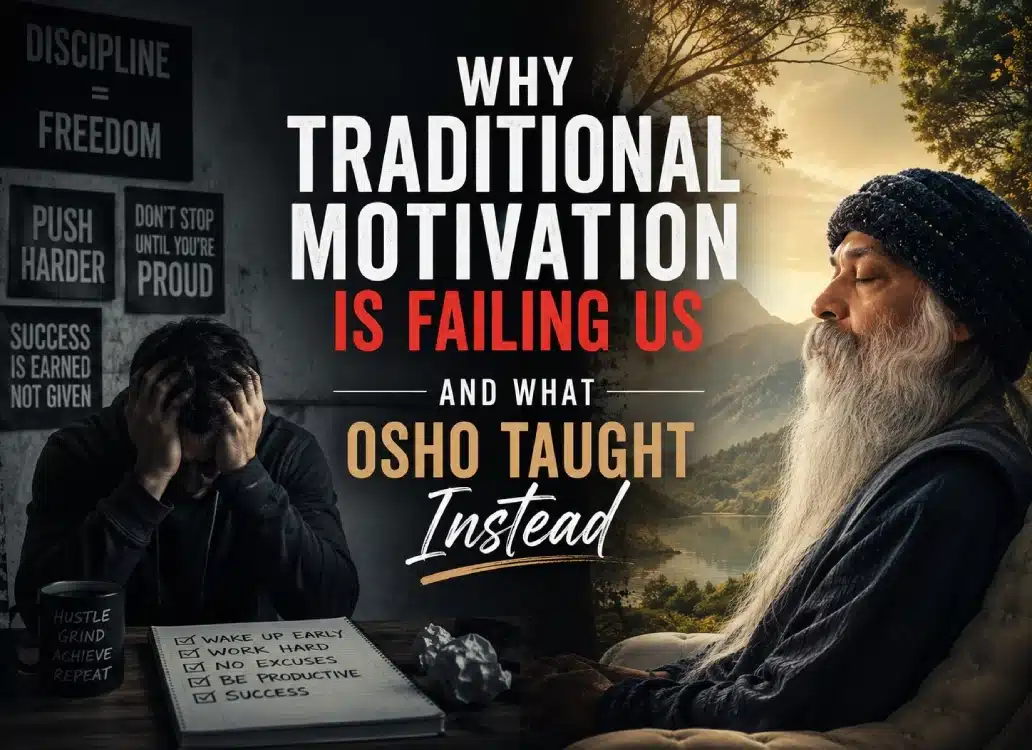
Open Instagram on any given morning, and the message is the same: wake up at 4 AM, grind through the pain, chase success at all costs. We now have more motivational content than any generation before us — and, by most measures, more burnout, anxiety, and quiet emptiness to go with it.
This isn’t a coincidence. Ambition and grind culture are marketed as virtues in almost every corporate and creative space, yet the people chasing them hardest are often the ones who feel worst. Search engines and modern psychology are increasingly exploring the gap between intrinsic and extrinsic motivation, but Osho was talking about this exact distinction decades before either “hustle culture” or “burnout” entered common vocabulary.
It’s tempting to read that as a discipline problem. It isn’t. The modern motivation industry runs on a single hidden assumption: that you are inherently incomplete, and that you need to keep “becoming” something else before you’re allowed to feel okay.
Osho, Bhagwan Shree Rajneesh, rejected that premise outright, decades before “hustle culture” even had a name. His argument was simple and genuinely radical for its time: motivation shouldn’t come from ambition. It should come from joy, presence, and play.
Ambition, left unchecked, pulls a person out of the present and makes their happiness conditional on a future that hasn’t arrived yet. A promotion, a number in a bank account, a launch date – the mind quietly outsources today’s peace to whichever milestone hasn’t happened yet.
Osho called this out directly. To him, forced motivation was a kind of psychological disease, because it made peace of mind contingent on some finish line that might arrive years late, or might never arrive at all.
It’s a familiar pattern in ambitious professional circles everywhere, Kolkata’s business community included: capable, talented people sacrificing a decade of “todays” for a retirement they’re too depleted to enjoy once it finally comes. Osho’s alternative isn’t “do less.” It’s: stop borrowing today’s happiness from a version of you that doesn’t exist yet.
A 4 AM motivational video works exactly like a stimulant: a rush of energy, followed by a crash a few hours later, followed by needing another video to get through the afternoon.
Osho was blunt about this. External motivation, he taught, is borrowed energy; it gives a temporary high and leaves a person more depleted and more dependent than before. Real drive, he said, has to come from within, spontaneously, the way a child doesn’t need a pep talk to spend three hours building a sandcastle.
Look closely at any daily routine, and the pattern usually holds: the work that never needs a hype video to start rarely needs one to sustain, either. The work that does need cheering on every single morning is usually work that was never truly wanted in the first place.
Osho taught that comparison is a form of self-insult, an assumption that human beings can be graded on the same scale, like products off an assembly line. He put it simply: “You are a unique individual. Nobody has ever been like you, and nobody will ever be like you again.”
Most people are ranked, graded, and compared from a young age, and that habit doesn’t switch off once school ends; it just changes shape, into LinkedIn milestones and other people’s business wins showing up in a feed at exactly the wrong moment. Osho’s point isn’t that ambition itself is wrong. It’s that comparing one person’s unfolding to another’s is like comparing a marigold to a rose because they didn’t bloom on the same schedule. Drop the comparison, and a surprising amount of psychological energy frees up — energy that was never really available for actual work while it was busy measuring itself against someone else’s highlight reel.
Much of the exhaustion around modern success comes from feeling forced to choose between two extremes: becoming a ruthless, materialistic workaholic, or abandoning ambition altogether for a passive, stagnant life.
Osho offered a third way, which he called Zorba the Buddha. Zorba the Greek represents full enjoyment of the material world — good food, wealth, passion, and ambition. Gautama Buddha represents total inner silence, detachment, and peace. Osho’s argument was that true success requires both at once: it’s possible to be deeply motivated to build something significant, while remaining internally detached from whether it succeeds or fails.
That duality is, in practice, what cures burnout. The engagement with the work stays furious; the identity attached to its outcome doesn’t. Succeed, and it’s wonderful. Fail, and what remains tends to be better, and considerably less exhausting to produce.
Osho used a word most people don’t grow up with: Leela, divine play. When work is done only for the paycheck or the outcome, it becomes labour, and labour drains a person. When work is done for the sheer act of doing it, it becomes play, and play energises.
This maps almost exactly onto what modern psychology calls the “flow state” – the condition where the ego quiets down, and a person becomes simply absorbed in what they’re doing. It shows up in small, specific moments: writing something that genuinely matters, a conversation with someone genuinely interesting, solving a problem with no deadline attached. None of it feels like grinding, and it tends to produce better results than the version that was chasing an outcome the whole time.
This isn’t just philosophy in the abstract; it has visibly reshaped how some genuinely accomplished people relate to success.
Filmmaker Mahesh Bhatt has spoken openly for years about how Osho’s teachings reshaped his relationship with his own creative ambition, moving him away from chasing external validation and toward making work he actually believed in. Actor Vinod Khanna went further still: at the height of a career that could have rivalled Amitabh Bachchan’s, he walked away from Bollywood entirely in 1982 to live at Osho’s commune in Pune, working as a gardener before eventually returning to filmmaking on his own terms, no longer driven by the same anxious ambition that had defined his earlier career.
Neither man had to abandon his career to take the underlying lesson. What both point to is a simple shift: when the need to prove something to an audience quiets down, so does the deadline-driven, caffeine-fuelled version of the work. The practical shift Osho points to isn’t complicated, even if it isn’t easy: stop asking “what will this get me?” and start asking “can genuine presence be brought to this exact task, right now?”
Most people treat rest as something to be earned, a guilty indulgence permitted only after physical or mental collapse. Osho flipped that completely. For him, doing nothing wasn’t wasted time; it was one of the highest states a person could occupy.
He used the image of a bow: kept drawn tight forever, it eventually snaps. It has to be relaxed before it can shoot the next arrow with any real power. That image is worth returning to on the days when stepping away from work feels like the least productive thing a person could possibly do.
Real rest, in Osho’s sense, isn’t collapsing in front of a screen – that’s just a distraction wearing rest’s clothes. It’s sitting silently, watching one’s own thoughts without judgement, and letting the system recharge without having to earn it first.
None of this needs to stay theoretical. A few practical starting points, drawn directly from Osho’s teaching. Audit one ambition: pick a goal currently being chased and ask honestly whether it brings joy today, or whether it’s being used to prove something to someone in some imagined future – and be willing to drop the ones that fail that test.
Separate the doing from the outcome. Borrowing from the Bhagavad Gita, which Osho referenced often, put full energy into the action itself and loosen the grip on the result. And sit still for fifteen minutes – no phone, no music, no app instructing how to meditate, just presence. It’s a small act, and also a quiet act of rebellion against a culture that demands productivity every single minute.
Traditional motivation asks people to keep proving themselves. Osho’s alternative asks for something harder, and far more sustainable: to actually show up, fully, in the life and work already at hand.